Work-Life Balance Is a Myth... Here Is What Actually Protects Your Peace
Oct 10, 2026
TL;DR
The perfect 50/50 work-life balance tends to leave you feeling guilty and behind. You protect your peace by managing your energy, making trade-offs on purpose, leaning into short seasons of focused imbalance, fully leaving work when you rest, and letting your values make the call instead of guilt.
-
A perfect 50/50 split is a myth, and chasing it is linked to higher anxiety.
-
Energy is the resource to protect, because time is fixed and energy can be restored.
-
Trade-offs you make on purpose turn guilt into clarity.
-
Real rest needs psychological detachment, and a short shutdown ritual helps you get there.
-
Values-based choices (“am I doing what matters most?”) replace guilt-based ones (“am I doing enough?”).
You close your laptop at 6:00 PM and the workday is officially over. Your brain does not get the memo. One unanswered email keeps pressing on your chest, and tomorrow's to-do list is already replaying in your head.
Your body is home. Your mind is still sitting at your desk.
If that sounds like your evenings, you are in good company... and you did nothing wrong. That heavy, running-in-place feeling comes from chasing something called work-life balance, an idea that was never going to work in a real life. Over the next few minutes, you will see why your energy matters more than your hours, and you will get one small shift that protects your peace tonight, without the dread of falling behind.
Why Is Work-Life Balance a Myth?
Picture the image you have been sold for years. A perfectly level scale. Career, ambition, and deadlines on one side. Family, friends, health, hobbies, and sleep on the other. The promise says that with enough effort and the right color-coded calendar, you can hit a perfect 50/50 split.
That promise sets you up to fail before you even start.
Life is messy, and it does not split evenly. So when you force a rigid 50/50 rule onto it, you feel like a failure the moment work gets intense or your family needs more of you. The data leans the same way. A 2022 study in the Journal of Occupational Health Psychology found that employees who chased work-life balance reported higher anxiety than those who accepted some overlap between work and personal life.
So the chase itself is part of what hurts. A demanding life will bring pain, and that part is unavoidable... the suffering on top of it is optional, and this myth keeps adding more of it.
💡 Your first takeaway: Swap the question. Instead of asking “how do I balance everything?” try asking “what needs my energy most right now, and what can wait?” It is a small change, and it moves you out of guilt and puts the choice back in your hands.
🔑 Key point: A perfect 50/50 split does not match how real life works, and chasing it tends to add stress. A better question is where your energy needs to go right now.
Why Does Energy Matter More Than Time?
Once you let go of perfect balance, you can look at the resource that actually runs your day... your energy.
Time is fixed. You get 24 hours, and there is no negotiating. Energy works differently, because it moves up and down and you can get it back. Some mornings you wake up focused, patient, and steady, and your to-do list feels light. Other mornings you wake up empty, and the exact same schedule feels like pushing a couch up a flight of stairs.
Research by Dr. Jim Loehr and Tony Schwartz found that 71% of participants saw a noticeable or substantial improvement in productivity and performance when they focused on building energy across mind, body, spirit, and emotions. Many of them were still outperforming their colleagues a full year later! 📈
How Do You Become an Energy Detective?
For one week, keep a notebook and track three things:
-
What drains you. Be honest, even if it feels petty. That one weekly meeting. Checking email the second you open your eyes.
-
What restores you. A walk outside. One specific song. A five-minute call with the friend who always makes you laugh.
-
What takes the most emotional effort. Give it a clear name, even if that name is your inbox.
Once you have a week of notes, the job gets simpler. Protect the things that restore you. Put them on your calendar first, before the draining items take over the day.
🔑 Key point: Your hours stay the same, while your energy changes day to day. Track what drains and restores you for one week, then schedule the restoring things first.
How Do Intentional Trade-Offs Protect Your Peace?
Running every part of your life at 100% all the time wears a person down. High performers tend to accept this, and they make their trade-offs on purpose.
Every yes has a cost. When you say yes to every project, every late-night message, and every request, something else pays for it. A lot of the time, your peace, your energy, or your closest relationships end up covering that bill.
Here is a scene you might know a little too well. It is 7:00 PM and your work phone buzzes. You tell yourself it is just one more email. That one decision takes the attention you were about to give your family at dinner, and it eats the first fifteen minutes of your brain's downtime.
Making trade-offs means you are living on purpose. Trouble shows up when guilt and fear make those trade-offs for you, by accident.
💡 Your challenge today: Pick one trade-off and make it on purpose. For example... “I am choosing to stop checking work notifications after 6:00 PM so I can be fully present at home.” When you choose the trade-off yourself, the guilt tends to turn into clarity. You are picking a priority, out loud.
🔑 Key point: Every yes costs you something somewhere else. When you make that trade-off on purpose, it feels like a choice instead of a loss.
What Is Focused Imbalance?
This leads to an idea often linked to Dr. Stephen Covey, author of The Seven Habits of Highly Effective People. A healthy life often includes stretches of focused imbalance, and that is okay.
Life moves in seasons. With a newborn, your energy pours into that child for a while. When you launch a business or face a huge deadline, work asks more of you for a short, specific window. That is healthy... as long as the season stays temporary.
Athletes train this way. Hard conditioning blocks work because planned recovery comes right after them. The trouble starts when you stay in the hard block and never put the recovery on the calendar.
So ask yourself one question. What season am I in right now? Career growth, deep family time, healing, or intense learning. Name it, then give yourself permission to lean into it for the next two weeks. You get to focus hard without the guilt, because you picked the season and you know it will end.
🔑 Key point: Leaning hard into one area for a season is normal and healthy. Name the season, keep it temporary, and plan the recovery that comes after.
Why Does Rest Sometimes Fail to Restore You?
You stopped working. You are on the couch, scrolling your phone, with one ear still listening for the work ping. It feels like rest... and somehow you get up just as tired.
Psychology has a name for what actually helps: psychological detachment. It means your mind fully leaves work when you are away from work. Research shows that mentally disconnecting during off-hours is most strongly related to lower fatigue, lower exhaustion, better sleep quality, and better long-term well-being.
If your body left the office and your mind stayed at the desk, your nervous system never gets the signal that you are safe. So it stays on high alert.
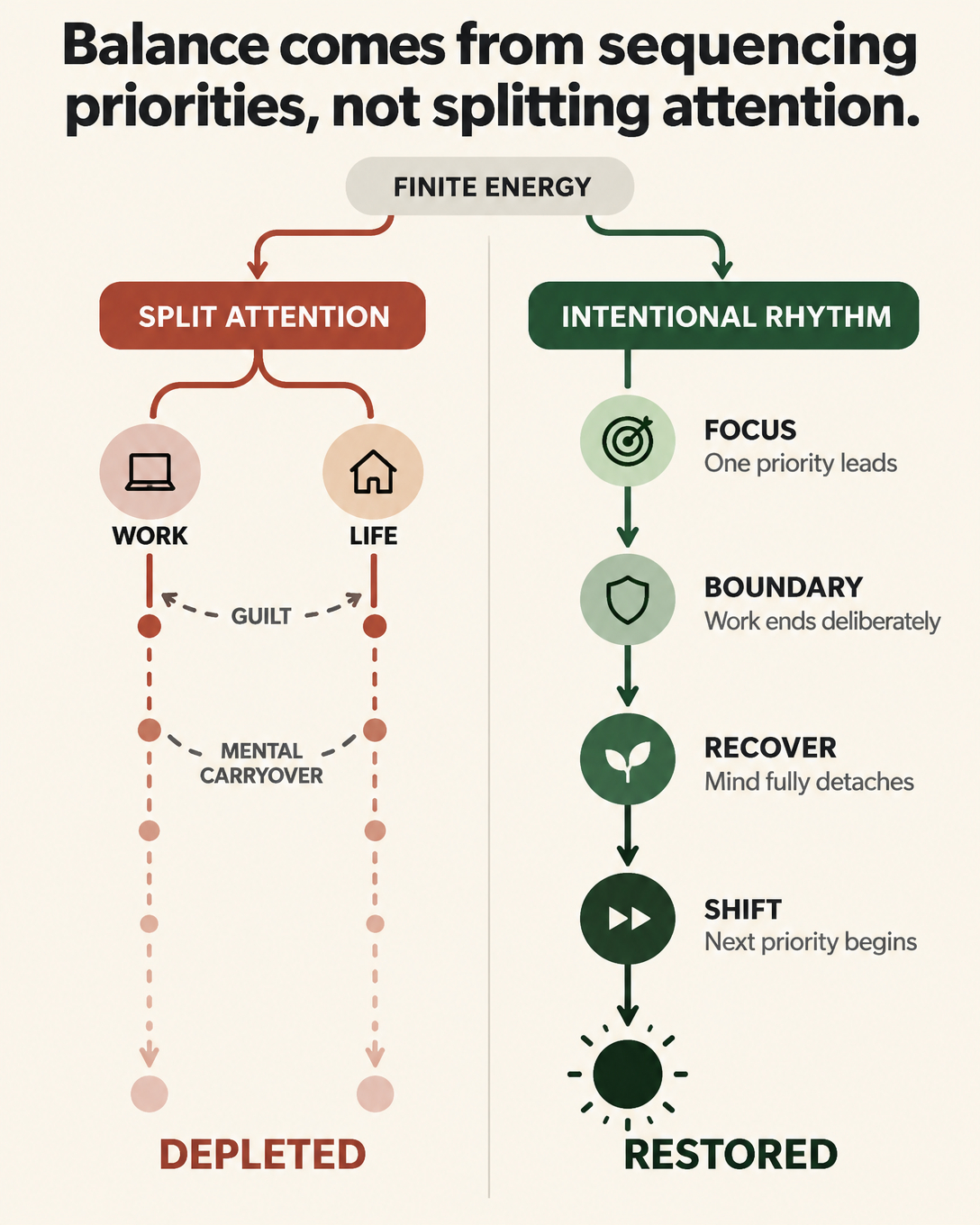
That is where a shutdown ritual helps a lot. It draws a firm line that tells your brain the workday is officially done.
How Do You Build a Three-Step Shutdown Ritual?
-
Write down the single most important task for tomorrow, on paper. That gets it out of your head and somewhere safe.
-
Close the laptop, silence work notifications, and put the work phone somewhere you cannot see it.
-
Do one small thing that has nothing to do with work. Change your clothes. Play one song. Stretch for two minutes. Water a plant, even the one you keep forgetting about. 🌱
The ritual is the bridge from your work life to your home life. It is short, and it gets easier every time you repeat it.
🔑 Key point: Rest only restores you when your mind leaves work too. A short shutdown ritual gives your brain a clear signal that the day is done.
What Does Guilt-Based Living Really Cost You?
Guilt is what keeps the balance myth alive. It is the voice whispering “you should be working” when you rest, and “you should be with your family” when you work. That push and pull inside your head feeds burnout, and the numbers are heavy. In 2025, 66% of U.S. employees report experiencing burnout, an all-time high, costing businesses $322 billion a year in lost productivity.
Guilt splits your attention. If you feel guilty while resting, the rest never really lands. If you feel guilty while working, your focus and creativity leak out. So you end up half here and half there, all day long.
The way out is a values-based operating system. Guilt keeps asking, “am I doing enough?” Your values ask something else... “am I doing what matters most?”
Next time guilt pulls at you, pause and run two questions:
-
What matters most in this exact moment? The report or the bedtime story. The right answer belongs to you, in that moment.
-
What would the person I want to become choose right now? This puts the decision back on your identity and your values.
Guilt will probably keep saying you are behind. That is fine. You can hear it and still let your values make the call.
🔑 Key point: Guilt pulls your attention in two directions and feeds burnout. Two quick values questions help you choose what matters most right now.
What Can You Do Tonight?
You now have a full system to work with. Name your season. Track your energy for one week. Make one intentional trade-off. Build your three-step shutdown ritual and run it tonight.
Protecting your peace is a skill, and skills grow with practice. So pick one idea from this article, whichever one feels easiest, and try it before bed tonight. Close the laptop, write down tomorrow's top task, then go be fully present with the people waiting for you on the other side. 💛
Frequently Asked Questions
Is work-life balance really a myth?
The perfect 50/50 version is. Life does not split evenly, and a 2022 study found that employees who chased balance reported higher anxiety than those who accepted some overlap between work and personal life.
What is the difference between time management and energy management?
Time management organizes your hours, which are fixed at 24 a day. Energy management protects the focus, patience, and emotional strength you bring to those hours, which change daily and can be restored.
How long should I track my energy?
One week is enough to start. Track what drains you, what restores you, and what takes the most emotional effort.
What does focused imbalance mean?
It means leaning into one area of life for a temporary season, like a newborn or a big launch, and then planning recovery afterward. The idea is often linked to Dr. Stephen Covey.
What is psychological detachment?
It means your mind leaves work when you are away from work. Research links it to lower fatigue, lower exhaustion, better sleep quality, and better long-term well-being.
What is a shutdown ritual?
It is a short routine at the end of the workday. Write down tomorrow's top task, close the laptop and silence notifications, then do one small thing unrelated to work. This tells your brain the day is over.
How do I stop feeling guilty when I rest?
Swap “am I doing enough?” for “am I doing what matters most?” Then ask what the person you want to become would choose right now.
Key Takeaways
-
The perfect 50/50 split tends to create guilt, and chasing it is linked to higher anxiety.
-
Energy is the resource to protect, because time is fixed and energy can be restored.
-
Every yes costs something, so make your trade-offs on purpose.
-
Seasons of focused imbalance are healthy when they stay temporary and recovery follows.
-
Real rest needs your mind to leave work, and a shutdown ritual helps it get there.
-
Let your values make the call by asking “am I doing what matters most?”
Pick one practice, run it tonight, and let yourself be off the clock for real. 🙌
Ready to Make a Positive Impact on Your Staff … & Your Business’s Bottom Line?
Schedule Mike Veny Today!
Mike’s Keynotes are Immersive & Rhythmic,
NOT Passive Lectures
- Learn practical tools for mental health and workplace well-being
- Experience an energizing session that combines rhythm and resilience-building training
- Retain and apply strategies through follow-up materials and toolkits
Hurry, Mike’s Speaking Calendar Fills Fast!
Act Now to Lock-In the Best Day & Time for Your Organization
Author